Beyond the Development · Research report
Beyond the Property: Is Community Becoming the Next Competitive Advantage in Residential Development?
Exploring whether changing lifestyle priorities are creating demand for residential developments designed around belonging, nature, privacy and shared experiences.
By BIOPHILIA Editorial Team · 23 September 2026 · 10 min
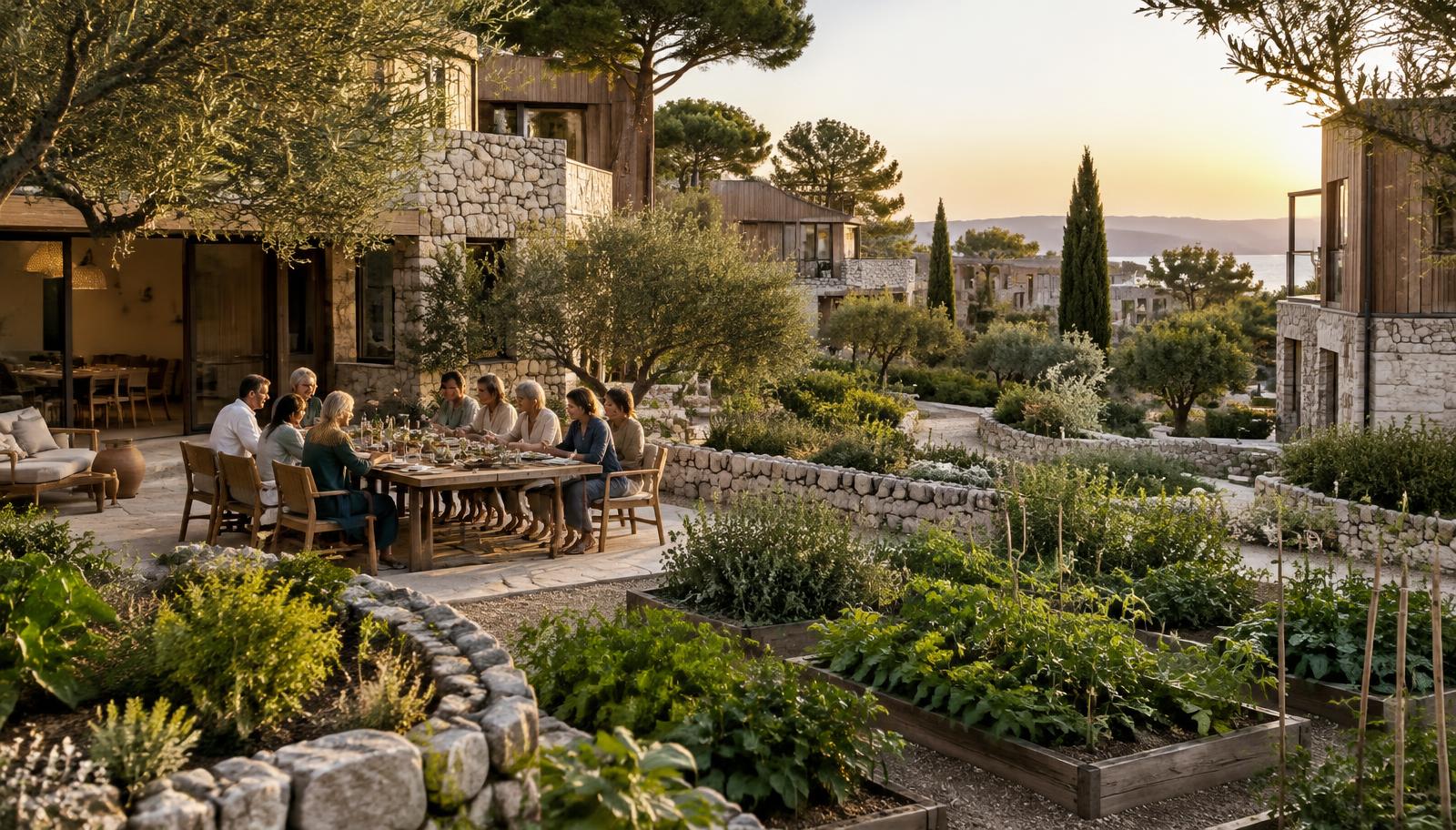
For decades, residential property has been marketed on location, architecture, size, amenities and price. These still matter most. But a growing body of research suggests buyers increasingly weigh something harder to put on a floor plan: the people around them, and how easy it is to belong. If that is true, it changes what developers are really selling. If it is only partly true, it matters to know for whom.
What the evidence says about changing preferences
In a 2024 Ipsos survey of more than 1,000 recent and intending homebuyers in the United States, commissioned by Century 21, 88 percent said they would compromise on elements of their dream home to live in a community that suited their household. Sixty-five percent of recent buyers reported a stronger connection to community after moving.
Research in the UK points the same way. In a 2025 study by Rightmove and the Home Builders Federation, 57 percent of respondents rated friendly neighbours as crucial and 54 percent said the same of quality parks and public spaces. A separate 2024 poll for the housing association Aster found that two-thirds of people consider a sense of community important when deciding where to live. And JLL's global consumer survey found that after safety and affordability, people of all ages most want more green space.
Community cannot simply be designed into existence. It can only be made possible.
The important caveat
It would be convenient to conclude that community is now what everyone wants. The data does not support that. In a 2020 Ipsos study for St. Modwen, UK respondents said they would prioritise a good quality home over an area with good community spirit by 43 percent to 16 percent. Younger generations were even more focused on the home itself, yet 35 percent of Gen Z said they would in principle be interested in cohousing.
The honest reading is this: community is rarely the first reason people buy, but it is increasingly a reason they choose one place over another, and a reason they stay. It works as a differentiator on top of a good home, not as a substitute for one.
From conventional to integrated: a spectrum of models
Community in residential development is not one thing. It ranges across a spectrum, each with different costs, buyers and risks:
- 1.
Conventional development
Private homes with little shared space. Lowest cost and complexity; community, if it forms, does so by chance.
- 2.
Planned communities
Master-planned neighbourhoods with parks, paths and amenities, run by a management company or owners' association.
- 3.
Themed communities
Developments built around a shared interest, such as agrihoods centred on farms and gardens, or wellness and active-living communities.
- 4.
Co-living and cohousing
Private homes plus significant shared facilities, with residents involved in decisions and daily life.
- 5.
Integrated living ecosystems
Places that combine living, work, hospitality, food and nature, with a curated community and long-term operation.
The further along the spectrum, the stronger the sense of community tends to be, and the narrower the audience. A survey of 22 agrihoods in the US found that sense of community was the strongest perceived value among residents. Research in elder cohousing found residents moved in search of community and were generally satisfied, with lower loneliness than the national average, though a quarter still reported feeling lonely.
What design can and cannot do
Master planning can make encounters more likely. Shared gardens, paths that pass front doors, a common house or kitchen, places to sit in the shade, and a small café or workspace all create opportunities for people to meet. Just as important is privacy: people engage more readily with neighbours when they can also withdraw. Good community design is a balance of both, not a choice between them.
What design cannot do is create relationships. A beautiful shared terrace that nobody manages, that has no clear rules, or that belongs to no one in particular will be empty within a year.
Why governance matters more than architecture
The communities that last tend to share a few features. They have clear, fair rules about shared spaces and costs. Someone, a manager, host or committee, is responsible for keeping things running. Residents have a real voice in decisions. And there is a reason to come together beyond the buildings: food, gardens, events, care for the landscape. Without this, community features become a cost line and, eventually, a point of conflict.
- Define from the start who owns, pays for and decides about shared spaces.
- Budget for ongoing community management, not just for construction.
- Give residents meaningful participation, gradually handing over responsibility.
- Curate the first residents carefully. Early culture shapes everything that follows.
The commercial reality for developers and investors
Community-oriented development is not automatically more profitable. Shared land reduces sellable area, common facilities add construction and operating costs, and management requires people and budget for years after the last unit is sold. Sales can also be slower when buyers are carefully selected.
The potential upside is real but must be proven, not assumed: clearer market differentiation, stronger word of mouth, lower resident turnover, more resilient values in a downturn and, in mixed-use settings, more year-round life. Agrihood research indicates that many prospective buyers say they would pay more or accept longer commutes for access to nature, social spaces and agricultural features. Stated willingness to pay is not the same as actual payment, which is why careful demand testing matters.
Who values community, and how much?
Different buyers look for different levels of integration:
- Families often value safety, nature, children's freedom to play outside and trusted neighbours.
- International professionals and remote workers often seek a ready-made social network, workspace and connectivity in a new country.
- Retirees often prioritise social contact, support and a sense of purpose, with access to healthcare nearby.
- Seasonal residents often want privacy and low maintenance, with light-touch community they can join when present.
A development that tries to serve all of them with the same offer usually serves none of them well. The more useful question is which mix of residents a place can genuinely support, and how much shared life each of them wants.
The BIOPHILIA perspective
Our philosophy is summed up in three words: People. Place. Community. In practice, this means beginning the residential development process with the lives people want to lead, rather than with what can be built on a particular parcel. It means designing for privacy and belonging at the same time, treating landscape and nature as shared assets, and planning the operation of a community as carefully as its construction.
We do not assume this approach suits every buyer or every site. We do believe that, where the audience exists, a well-governed community can be one of the most durable sources of value a development can offer. It is also the thread connecting all three articles in this series: from golf, to year-round destinations, to the places where people choose to live.
Let's discuss your project
Are you planning a residential or mixed-use development and asking how community, nature and long-term value fit together? We are glad to share our perspective.
Get in touchSources
Survey figures are taken from the sources below as published. Most come from the US and UK and are cited as indicators, not as data on the Croatian market.
- Century 21 Real Estate / Ipsos (2024): Connection, Community and Joy, Today's Homebuyers
- Home Builders Federation / Rightmove (2025): A sense of community with quality amenities
- Ipsos for St. Modwen (2020): Housing wish lists shift post lockdown
- JLL (2024): Urban housing, one area generations agree on
- Aster Group (2024): CommuniPolling Insight Briefing
- Umstattd Meyer et al. (2026): Understanding demand for agriculturally integrated neighborhoods. Journal of Agriculture, Food Systems, and Community Development
- Stinnett, University of Washington (2022): The Goat Next Door, community dynamics in agrihoods
- Glass (2019): Sense of community, loneliness, and satisfaction in five elder cohousing neighborhoods. Journal of Women & Aging
BIOPHILIA Editorial Team
Beyond the Development is BIOPHILIA's editorial series on responsible property and destination development, with Croatia as its initial focus. Each article tests its assumptions against evidence rather than simply supporting our own philosophy.