Beyond the Development · Analysis
What Makes a Property Development Opportunity Investable?
Six dimensions that turn development potential into a proposition an investor can meaningfully assess.
By BIOPHILIA Editorial Team · 9 December 2026 · 9 min read
Property development investment opportunities often arrive as a persuasive combination of land, location and possibility. The difficult question is not whether something attractive could be built. It is whether a particular development strategy can be justified, funded and executed under conditions that the parties understand. That distinction separates potential from investment readiness.
1. An attractive idea is not yet an investable project
A sea view can be genuine while the commercial proposition remains uncertain. A rendering may communicate design intent beautifully without establishing access, infrastructure capacity, construction cost or customer demand. None of this makes early-stage opportunities inherently unsuitable. It means their uncertainties must be identified and reflected in the proposed transaction.
Investability is also relative to the investor and the stage. A land specialist may accept planning uncertainty that a construction lender will not. A long-term owner may assess operating quality differently from a developer seeking sales on completion. The useful question is therefore: investable for whom, on what evidence, under which conditions, and with what exposure if the assumptions fail?
2. Location must support a specific market
Desirability and suitability are not interchangeable. Accessibility, infrastructure, neighbouring development and everyday services shape what a location can support. A hillside setting may offer privacy and views while introducing access, servicing or construction challenges. Those characteristics need to be assessed against a defined customer, rather than treated as universal advantages.
Demand evidence should go beyond enthusiasm for a destination. Who is expected to buy or occupy the homes, what alternatives do they have, and what would make them choose this proposition? Asking prices are not the same as completed transactions. Enquiries are not commitments. Relevant comparables, competing supply, buyer interviews and realistic sales periods help distinguish a market hypothesis from a defensible assessment.
3. Land and planning questions belong at the beginning
Before refining the architecture, establish what is being acquired and what remains to be verified. Ownership structure, registered rights and encumbrances, cadastral information, boundaries and lawful access all matter. Where land-registry records, cadastral data and conditions on the ground appear inconsistent, the discrepancy needs professional investigation rather than an optimistic explanation.
Planning review should examine the applicable designation and constraints, the status and scope of any permissions, and the route required for the intended proposal. Infrastructure availability is a separate question: a nearby road or utility connection does not, by itself, demonstrate adequate capacity or an agreed connection arrangement. Unresolved matters can affect design, cost, timing and funding eligibility simultaneously.
Public Croatian land and planning portals are useful starting points, not substitutes for transaction-specific legal and technical advice. This article is a commercial evaluation framework, not a legal opinion or confirmation of any project's status. Current documentation and appropriately qualified professional review are required before a commitment.
4. The concept must connect customer, place and product
A credible concept explains who the project serves, what it offers and why that offer belongs on this site. Architectural quality matters, but so do layouts, privacy, accessibility, storage, parking where appropriate, and the practical relationship between indoor and outdoor space. A compelling image cannot compensate for homes that do not work well in daily use.
Differentiation should also survive an economics discussion. Additional amenities can increase appeal while adding construction expense, maintenance obligations and management complexity. The concept needs a clear operating logic: who maintains shared areas, how responsibilities are organised, and whether the intended users value the features enough to justify their whole-life cost. Design and feasibility should inform each other rather than proceed in separate lanes.
5. Economics must withstand an uncomfortable scenario
A development appraisal should account for more than land and the main construction contract. Professional fees, surveys, site preparation, infrastructure, applicable taxes and charges, financing, insurance, sales costs and contingencies can materially change the picture. Where assets will be retained, operating costs, maintenance and replacement expenditure also belong in the assessment. Assumptions should identify their source, date and level of confidence.
Revenue requires equal discipline. Expected pricing, saleable area, sales pace and payment timing must be internally consistent. A higher sales assumption does not repair an unsupported cost estimate. Nor does an apparently positive margin answer the cash-flow question: the project may need substantial funding well before revenue becomes available.
Sensitivity analysis should test slower sales, lower achieved prices, cost escalation and delays, including combinations of these pressures. The objective is not to produce a dramatic worst-case slide. It is to understand additional capital requirements, decision points and limits beyond which the strategy should change or stop. A credible proposal makes its vulnerabilities visible.
6. Execution depends on coordination, not a list of names
Architecture, engineering, legal advice, planning, financing, construction, sales and operations need to form a coordinated delivery structure. Relevant experience matters, but so does knowing who owns each decision. Who approves scope changes? Who checks cost implications? Who reports emerging risks, and who has authority to act before a manageable issue becomes an expensive delay?
An execution plan should connect dependencies, procurement choices, funding conditions and decision gates. An unresolved access question should not disappear inside a confident programme. BIOPHILIA's services can be structured end-to-end or around selected modules, depending on the assignment. Neither arrangement should be read as a universal financing commitment or a substitute for an agreed scope, responsibilities and funding plan.
7. Long-term value includes environmental and operating reality
Resource availability and environmental constraints are part of feasibility, not a decorative sustainability chapter. Water demand, energy performance, drainage, heat exposure and site-specific hazards can affect design and future operating costs. Materials and landscaping should be assessed for durability and maintenance in local conditions, not just their appearance at handover.
The wider destination matters too. Seasonality influences services, occupancy patterns and the viability of amenities. BIOPHILIA's analyses of golf tourism and year-round destinations explore these broader development questions. They provide context, not evidence of demand for an individual project. Long-term value depends on whether the proposed product remains useful, maintainable and appropriate for its setting.
8. A practical six-dimension investment-readiness framework
The following framework is a discussion tool, not a certified assessment or guarantee of performance. For each dimension, record the evidence available, the unresolved question, the person responsible and the next decision gate. Avoid averaging away a critical weakness: strong demand cannot resolve defective access, and excellent design cannot fill a funding gap.
- 1.
Market
Define the intended customer and competing offer. Identify evidence supporting pricing and absorption, and distinguish observed transactions from assumptions.
- 2.
Land and legal status
Document ownership, rights, access, planning status and infrastructure questions. Identify which uncertainties require resolution before any binding commitment.
- 3.
Development concept
Test the proposed product against customer needs, site constraints and operating requirements. Establish what is essential and what can change.
- 4.
Economics
Build a complete cost, revenue and cash-flow assessment. Test downside scenarios and identify the capital needed if the preferred case does not materialise.
- 5.
Execution
Assign responsibilities, dependencies and approval rights. Confirm which capabilities are appointed, which remain to be procured and how changes will be controlled.
- 6.
Long-term value
Examine resource use, resilience, maintenance and destination fit. Clarify who bears ongoing obligations and how those obligations affect the proposition.
A useful outcome is not simply a green light. It may be a conditional next step, a narrower scope, a revised structure or a decision not to proceed. Clear reasons for pausing are evidence of investment discipline, not a failure of ambition.
9. MYRON VILLAS: applying the questions to a real opportunity
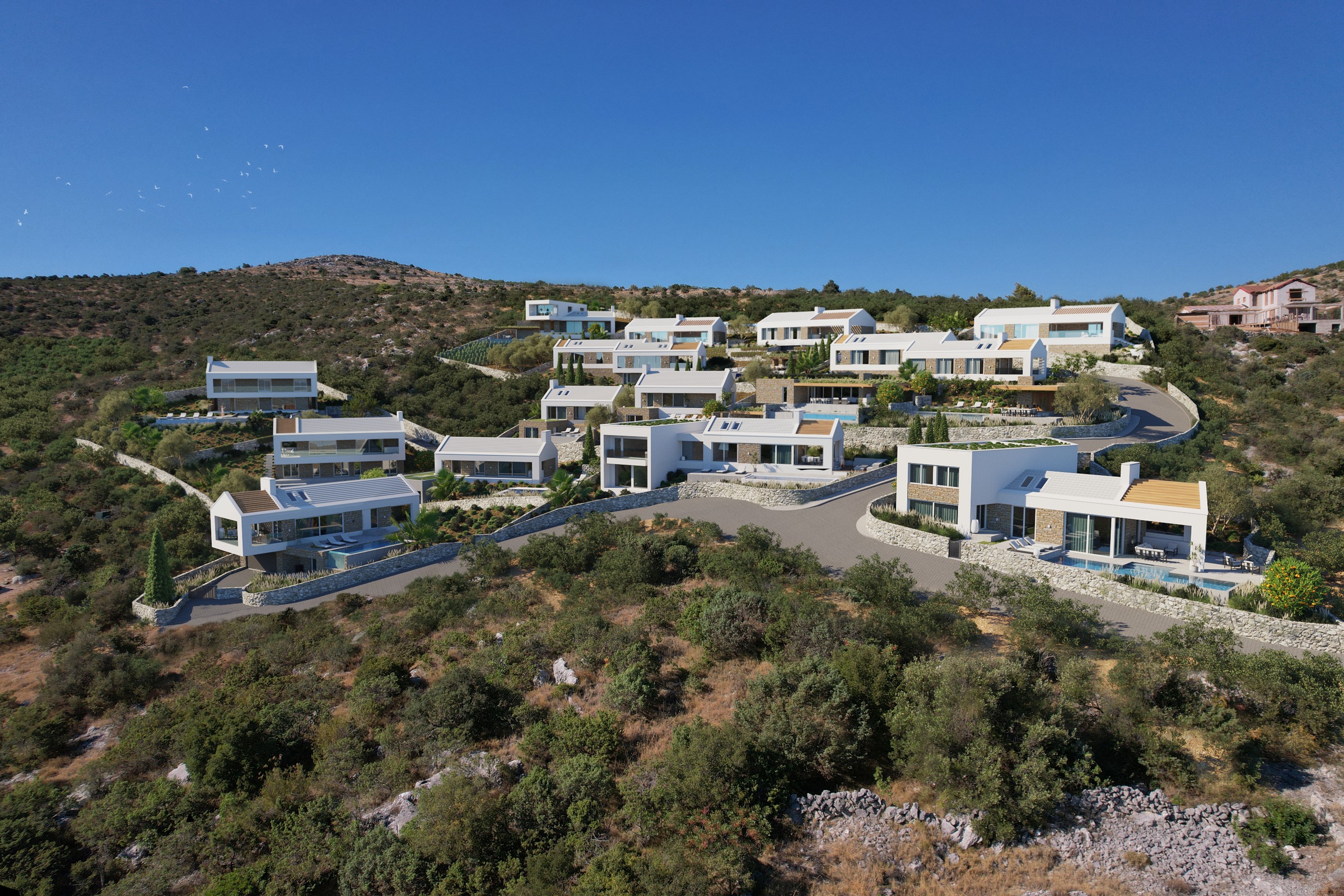
MYRON VILLAS is a residential land and development opportunity on a hillside in the Rogoznica area of Croatia. It is not a completed villa development. Its approved concept imagery can help communicate a possible direction, but imagery does not establish permissions, construction readiness or financial performance. Evaluation should begin with the current project information and supporting documentation.
Acquiring land, evaluating a development concept and exploring co-development are different decisions. A land acquisition requires clarity on the asset and rights being transferred. Concept evaluation asks whether the proposed product is appropriate and feasible. A potential co-development arrangement additionally requires agreement on contributions, governance, funding responsibilities, risk allocation and exit provisions. None should be inferred from the others.
For MYRON VILLAS, the sensible next step is to request current materials, identify the contemplated transaction and build a proportionate diligence scope. Plot sizes, sales status, permissions, timetable and investment outcomes should not be assumed. The opportunity becomes assessable through evidence and agreed conditions, not through confidence of presentation alone.
Start with the information, not the conclusion
Interested in evaluating MYRON VILLAS or discussing another development opportunity? Contact BIOPHILIA to request project information or an exploratory conversation about the questions, evidence and expertise your next decision requires.
Contact BIOPHILIASources and reference points
Public portals and policy resources support the general evaluation framework; they do not verify project-specific rights, approvals or feasibility. MYRON VILLAS is BIOPHILIA primary project material and should be read alongside current supporting documents. The planned publication date is not a verification date.
BIOPHILIA Editorial Team
BIOPHILIA Editorial Team. Beyond the Development is BIOPHILIA's editorial series examining the decisions, evidence and responsibilities behind property development.